Expert Skin Care in Singapore
Personalised Skin & Beauty Solutions
Beauty Treatments for Radiant Results
- Home
- Treatments
- RevitaGrow Hair Regrowth Treatment Singapore
- Hair Rejuvenation Treatment Singapore
- PurifyScalp Detox Treatment Singapore
- Tone & Body Sculpting Treatment Singapore
- All-Inclusive Glow-Up Treatment in Singapore
- Non-Surgical Body Contouring Treatment Singapore
- CurveLift Sculpting Treatment Singapore
- Rejuve-Eye Lifting Treatment Singapore
- Precision Pore Tightening Treatment Singapore
- Neck & Jaw Lifting Singapore
- Korean Facial Treatment in Singapore – Baby Face Therapy
- Diamonte Anti-Aging Facial Treatment in Singapore
- Brightening Facial Treatment in Singapore
- Cryo Lifting Facial & Cryotherapy Skin Repair Treatment in Singapore
- Products
- Gallery
- Our Story
- Blog
- Contact Us

- Home
- Our Story
- Aesthetic Treatments in Singapore
- RevitaGrow Hair Regrowth Treatment Singapore
- Hair Rejuvenation Treatment Singapore
- PurifyScalp Detox Treatment Singapore
- Tone & Body Sculpting Treatment Singapore
- All-Inclusive Glow-Up Treatment in Singapore
- Non-Surgical Body Contouring Treatment Singapore
- CurveLift Sculpting Treatment Singapore
- Rejuve-Eye Lifting Treatment Singapore
- Precision Pore Tightening Treatment Singapore
- Neck & Jaw Lifting Singapore
- Korean Facial Treatment in Singapore – Baby Face Therapy
- Diamonte Anti-Aging Facial Treatment in Singapore
- Brightening Facial Treatment in Singapore
- Cryo Lifting Facial & Cryotherapy Skin Repair Treatment in Singapore
- Treatment Booking
- Products
- Blog
- Gallery
- Contact Us
- Call Us
- Home
- Our Story
- Aesthetic Treatments in Singapore
- RevitaGrow Hair Regrowth Treatment Singapore
- Hair Rejuvenation Treatment Singapore
- PurifyScalp Detox Treatment Singapore
- Tone & Body Sculpting Treatment Singapore
- All-Inclusive Glow-Up Treatment in Singapore
- Non-Surgical Body Contouring Treatment Singapore
- CurveLift Sculpting Treatment Singapore
- Rejuve-Eye Lifting Treatment Singapore
- Precision Pore Tightening Treatment Singapore
- Neck & Jaw Lifting Singapore
- Korean Facial Treatment in Singapore – Baby Face Therapy
- Diamonte Anti-Aging Facial Treatment in Singapore
- Brightening Facial Treatment in Singapore
- Cryo Lifting Facial & Cryotherapy Skin Repair Treatment in Singapore
- Treatment Booking
- Products
- Blog
- Gallery
- Contact Us
- Call Us
Ever caught your reflection and wondered, “When did my skin start looking tired?” Or maybe you’re in your late 20s, looking at a skincare ad, wondering if you’re too young to even think about this. Here in Singapore, the humidity, the sun, and our busy city life keep our skin working hard. It often shows sooner than we’d like.
So what’s the best age to start skin tightening? It’s a question more Singaporeans are asking earlier these days, and the honest answer isn’t a single number. It’s about understanding your own skin, and knowing when it makes sense for you.
Let’s break it down, simply and clearly.
What Is the Best Age to Start Skin Tightening?
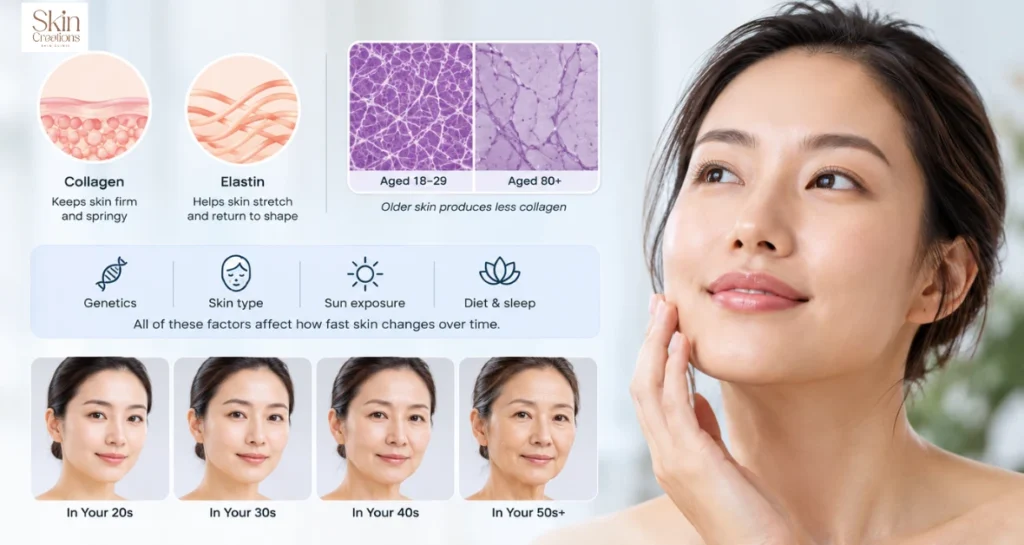
There’s no universally “correct” age to start skin tightening. Age-related changes in the skin happen gradually across adulthood, and when treatment makes sense depends more on your skin’s condition, your goals, and how much firmness you’ve noticed changing, not on hitting a specific birthday.
That said, it helps to understand what’s happening underneath. Collagen is the protein that keeps skin firm and springy, and its production naturally slows with age. Elastin works alongside it, helping skin stretch and return to shape after you smile, frown, or move your face. A 2006 study in the American Journal of Pathology compared skin cells from adults aged 80 and above with those from people between 18 and 29, and found the older group produced noticeably less collagen.
Genetics, skin type, sun exposure, and daily habits like diet and sleep all affect how fast this happens too. Two people the same age can have very different skin, which is exactly why age alone isn’t the full picture.
For some people, that means starting treatment in their late 20s or early 30s, while noticeable changes are still mild. For others, it makes more sense to wait until firmness has changed enough to bother them. Both are reasonable starting points, the right one depends on you.
Why Your Skin Ages Faster in Singapore's Climate
Age isn’t the only factor here. Where you live matters too, and Singapore’s climate puts extra strain on your skin.
Our humidity keeps skin feeling damp on the surface, but that doesn’t mean it’s well hydrated underneath. Add in strong year-round UV exposure, and skin faces steady stress almost every day of the year. UV rays are known to activate enzymes called MMPs, which break down collagen faster than natural ageing alone, a process known as photoaging. City living adds another layer, since pollution exposure is linked to oxidative stress in skin, which may also contribute to collagen breakdown over time.
For some people, this combination may explain why signs of skin ageing show up sooner than expected, not because of age alone, but because of what their skin faces every day.
Best Age to Start Skin Tightening: Breakdown by Life Stage
Not sure which stage fits you? Watch for skin that feels less bouncy, fine lines that show up even when your face is relaxed, a jawline that looks softer than before, or skin that looks dull no matter how much sleep you get.
These are general patterns, not a checklist for when you “should” act. Think of them as a way to understand what’s typically happening at each stage, not a deadline.
In Your 20s
Most people in their 20s don’t see obvious changes yet. Collagen synthesis begins its slow decline in this decade, even though skin still looks and feels firm. Sun exposure and city pollution can build quietly in the background over time. Some people choose to start light, preventive care during this decade simply to stay ahead of changes, though there’s nothing wrong with waiting until you actually notice something worth addressing.
In Your 30s
Collagen decline tends to become more measurable during this decade, and the first small signs may appear: fine lines around the eyes, slightly less firmness along the cheeks or jaw. Because any changes are often still mild at this stage, some people find their skin responds well to treatment, but that’s not a rule, and plenty of people in their 30s see no need to start yet either.
In Your 40s
By your 40s, collagen loss tends to add up in more visible ways. This can show up as jowls, sagging skin along the jaw, or deeper folds near the mouth and nose, though how much and how visibly varies a lot from person to person. This doesn’t mean anything went wrong. It’s simply a common part of this stage for many people. Treatments here are sometimes slightly more involved, but results can still meaningfully restore firmness and shape.
In Your 50s and Beyond
Skin changes are often more established by this stage. For women, declining estrogen levels around menopause are associated with faster collagen loss, on top of the gradual decline that’s already been happening for decades. Many people choose a combination of treatments at this stage, with realistic expectations and a plan built around their skin’s current needs, not a one-size-fits-all approach. Starting now still brings real, visible improvement for most people. It’s never too late to explore what might help.
If you’re not sure whether you need skin tightening, or which treatment type would suit your skin best, Skin Creations, an aesthetic clinic in Singapore can help. Our team of expert aestheticians will examine your skin and recommend the best treatment for your skin type and goals.
Signs You Might Want to Consider Skin Tightening
Since there’s no set age that applies to everyone, your skin’s condition is really the better guide, and there are some common signs that tend to show up when firmness starts to shift, regardless of what decade you’re in.
- Your skin feels a little less springy. It takes a moment longer to bounce back after you smile or make an expression.
- Fine lines show up even when your face is completely relaxed, not just when you smile or squint.
- Your jawline or cheeks look softer or less defined, even without any real change in weight.
- Mild sagging appears around the eyes, jowls, or neck, skin that used to sit closer to the muscle starts to loosen.
- Skin looks dull or slightly crepey, even when sleep and hydration haven’t changed.
Whichever decade matched you above, these signs are what actually matter. It’s your skin telling you something, not your age. If a few of these sound familiar, that’s a better cue to look into treatment than your age alone.
Skin Tightening Treatments Available in Singapore
Once you have a sense of what your skin needs, the next step is understanding your options. Clinics in Singapore offer a few main types of skin tightening treatments for loose or sagging skin, each working in a different way.
- Radiofrequency (RF): Delivers controlled heat energy into the skin’s deeper layers, which can stimulate collagen production over time. RF is typically suited to mild skin laxity, including early changes around the cheeks and jawline. Visible firming usually develops gradually over several weeks as collagen production increases, and downtime is generally minimal.
- Ultrasound-based: Uses focused ultrasound energy to reach deeper layers of tissue. Some technologies can target the SMAS layer, the same layer addressed during surgical facelift procedures, without cutting the skin. These treatments are often considered for mild to moderate skin laxity, particularly around the jawline and neck, with suitability depending on the specific device and individual skin condition. For a closer comparison of ultrasound-based options, Ultherapy vs HIFU covers the technology, results, and cost differences.
- Laser-based: Uses light energy to heat targeted areas of the skin. Depending on the wavelength and device, laser treatments can address firmness alongside concerns such as uneven texture, pigmentation, or fine lines. Fractional and non-ablative lasers generally involve less downtime than more intensive ablative laser resurfacing.
Most of these fall under non-invasive or non-surgical care, generally involving less downtime than surgical options, which is part of why non-invasive skin tightening has become popular among busy Singaporeans. At Skin Creations, treatments like Diamonte Anti-Aging are designed to target firmness and overall skin ageing. The right choice depends on your skin, your goals, and what stage you’re at.
Every treatment works differently for every person, so it’s worth discussing your options with a licensed practitioner before deciding what’s right for you.
Common Myths About Age and Skin Tightening
There’s a lot of confusion out there about when skin tightening actually makes sense. Let’s clear up a few common myths.
- Myth: There’s an ideal age you have to hit before starting. There isn’t a scientifically established “correct” age. Some people start early to stay ahead of changes, others wait until firmness has shifted enough to matter to them. Neither approach is more “right” than the other, it depends on the individual.
- Myth: It’s only for older people. This myth probably comes from how skin tightening is marketed, often shown as a fix for older skin. In reality, people explore it at different stages for different reasons, prevention for some, restoration for others. Neither is more “correct” than the other.
- Myth: Once you start, you can’t stop. There’s no lock-in. Skin tightening isn’t a subscription or a routine you’re obligated to continue. It’s a choice you can revisit whenever it makes sense for you, and stepping away doesn’t undo the progress you’ve already made.
Conclusion
So, is there one perfect age to start skin tightening? Based on what we actually know, no. Collagen changes happen gradually across adulthood, and Singapore’s climate may add to that over time, but the right time to start depends on your skin, your concerns, and your goals, not a specific number.
What matters most isn’t hitting some ideal age, it’s understanding your own skin and choosing care that fits where you are right now. Confidence isn’t about age. It’s about feeling comfortable in the skin you’re in, at every stage.
You don’t need to have it all figured out before booking a consultation. If you’re in Singapore, Skin Creations offers personalised consultations at their Orchard Road and City Gate outlets, with treatment plans built around your skin, not a one-size-fits-all approach.
Book a consultation and let their team help you figure out what’s right for your skin.
FAQs
Does skin tightening hurt?
Many non-invasive treatments involve a warm sensation on the skin, sometimes compared to a hot stone massage. Some methods may cause mild discomfort during the session, though tolerance varies by person and treatment type.
How long does it take to see results from skin tightening?
Results tend to build up gradually as your body produces new collagen. Some people notice early changes within a few weeks, while fuller results can take longer to appear, timelines vary by treatment and individual.
How many sessions do I need?
The number of sessions depends on the treatment and your skin's needs. Some protocols involve just one session, others recommend a series spaced weeks apart. Your practitioner can recommend a plan suited to you.
How long do skin tightening results last?
This varies by treatment type and by person. Some methods offer longer-lasting results with good skin care, while others may involve maintenance sessions over time to sustain the effect.
Is skin tightening safe?
Non-invasive skin tightening is generally considered safe when performed by a licensed practitioner, though suitability depends on individual health factors. It's often not recommended during pregnancy, with certain skin infections, or while taking specific medications, so a proper consultation matters before starting.
Recent Posts
Contact Details
Contact Details