Expert Skin Care in Singapore
Personalised Skin & Beauty Solutions
Beauty Treatments for Radiant Results
- Home
- Treatments
- RevitaGrow Hair Regrowth Treatment Singapore
- Hair Rejuvenation Treatment Singapore
- PurifyScalp Detox Treatment Singapore
- Tone & Body Sculpting Treatment Singapore
- All-Inclusive Glow-Up Treatment in Singapore
- Non-Surgical Body Contouring Treatment Singapore
- CurveLift Sculpting Treatment Singapore
- Rejuve-Eye Lifting Treatment Singapore
- Precision Pore Tightening Treatment Singapore
- Neck & Jaw Lifting Singapore
- Korean Facial Treatment in Singapore – Baby Face Therapy
- Diamonte Anti-Aging Facial Treatment in Singapore
- Brightening Facial Treatment in Singapore
- Cryo Lifting Facial & Cryotherapy Skin Repair Treatment in Singapore
- Products
- Gallery
- Our Story
- Blog
- Contact Us

- Home
- Our Story
- Aesthetic Treatments in Singapore
- RevitaGrow Hair Regrowth Treatment Singapore
- Hair Rejuvenation Treatment Singapore
- PurifyScalp Detox Treatment Singapore
- Tone & Body Sculpting Treatment Singapore
- All-Inclusive Glow-Up Treatment in Singapore
- Non-Surgical Body Contouring Treatment Singapore
- CurveLift Sculpting Treatment Singapore
- Rejuve-Eye Lifting Treatment Singapore
- Precision Pore Tightening Treatment Singapore
- Neck & Jaw Lifting Singapore
- Korean Facial Treatment in Singapore – Baby Face Therapy
- Diamonte Anti-Aging Facial Treatment in Singapore
- Brightening Facial Treatment in Singapore
- Cryo Lifting Facial & Cryotherapy Skin Repair Treatment in Singapore
- Treatment Booking
- Products
- Blog
- Gallery
- Contact Us
- Call Us
- Home
- Our Story
- Aesthetic Treatments in Singapore
- RevitaGrow Hair Regrowth Treatment Singapore
- Hair Rejuvenation Treatment Singapore
- PurifyScalp Detox Treatment Singapore
- Tone & Body Sculpting Treatment Singapore
- All-Inclusive Glow-Up Treatment in Singapore
- Non-Surgical Body Contouring Treatment Singapore
- CurveLift Sculpting Treatment Singapore
- Rejuve-Eye Lifting Treatment Singapore
- Precision Pore Tightening Treatment Singapore
- Neck & Jaw Lifting Singapore
- Korean Facial Treatment in Singapore – Baby Face Therapy
- Diamonte Anti-Aging Facial Treatment in Singapore
- Brightening Facial Treatment in Singapore
- Cryo Lifting Facial & Cryotherapy Skin Repair Treatment in Singapore
- Treatment Booking
- Products
- Blog
- Gallery
- Contact Us
- Call Us
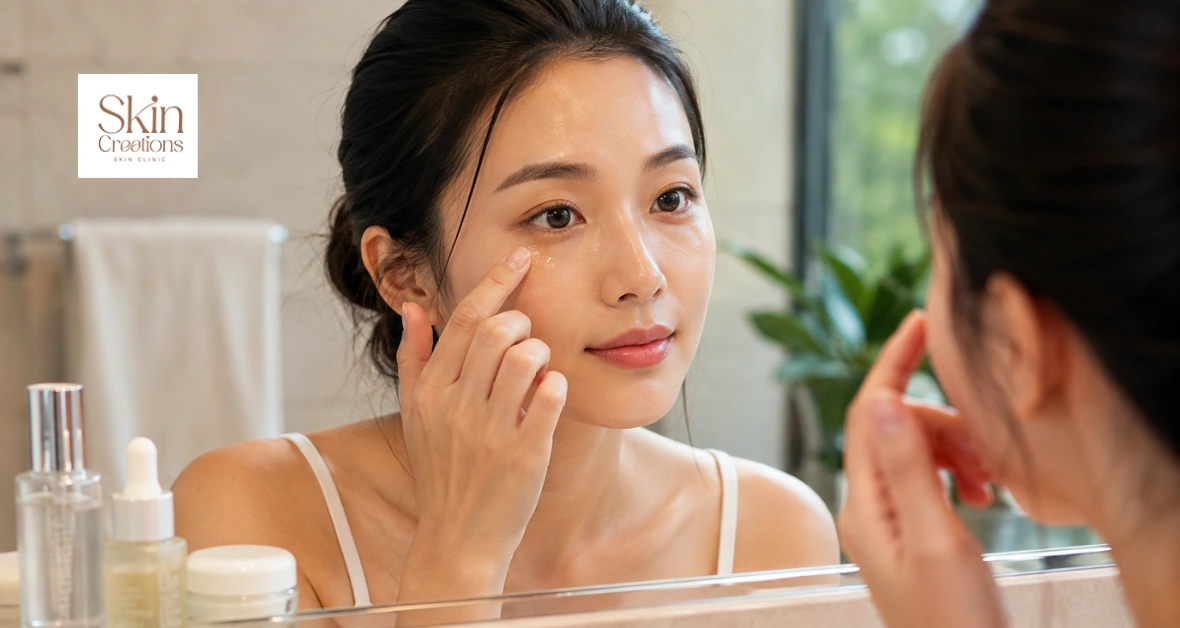
Look under your eyes in a bright mirror, and you’ll see skin that’s nothing like the rest of your face. It’s often about 0.5 millimetres thick, compared with nearly 2 millimetres almost everywhere else. That’s why this is the first place lines tend to show up, and that’s why figuring out how to reduce wrinkles under the eyes takes something different from your usual skincare routine.
That doesn’t mean skincare is useless; sun protection and a proper hydrating eye product still go a long way, especially for lines that still fade once your face relaxes. But if a line’s still there when you’re not squinting, not laughing, just sitting still, skincare alone may not be enough. That’s usually when it’s worth looking at something that works on collagen and skin structure directly, not just sits on top of the skin.
So let’s start with why this area ages differently in the first place. Once that clicks, the “what to do” part makes a lot more sense.
What Causes Under-Eye Wrinkles in the First Place
This isn’t bad luck. Your under-eye skin is simply built different from the rest of your face, and once you understand what causes fine lines under the eyes, the wrinkles start to make sense.
Three things work against this area from day one:
- It has fewer oil glands than most other facial skin. With less natural oil to hold onto moisture, this area dries out faster and shows irritation more easily.
- It starts out thinner. Thinner skin means less structural support underneath it, even before age becomes a factor.
- It moves constantly. Every blink, squint, and smile bunches this skin up, then lets it go again. That happens thousands of times a day.
Now let’s talk about collagen and elastin, the two things doing the real work under your skin. Collagen is like scaffolding that supports the skin. Elastin is like a rubber band that snaps skin back into place after it stretches. Research on skin ageing generally points to collagen declining gradually through adulthood, with some studies estimating an average of around 1 percent a year, though this varies by person. That’s just ageing; nothing has gone wrong. But this area starts with less collagen than the rest of your face. So it shows that decline first.
Blinking and squinting matter more than you’d think. In your twenties, elastin snaps skin back fast. A squint line disappears the second you stop squinting. As elastin fades, that snap-back gets slower. The line sticks around a little longer each time. Eventually, it stops disappearing at all. That’s the real distinction worth knowing: a temporary crease that comes and goes with expression is a dynamic line, while one that’s still visible even when your face is completely relaxed is what people usually mean by a wrinkle.
One more thing worth knowing. Dehydration does not cause new wrinkles. But it makes the wrinkles you already have look worse. Dry skin sits lower and thinner, so your lines cast more shadow and look deeper. Hydrate your skin well, and those lines will look softer. They will not disappear completely, though, since dehydration was never the real cause.
What Causes Under-Eye Wrinkles in Singapore's Climate
Everything you just read happens everywhere in the world. But local weather and lifestyle add a few extra causes, and if you live in Singapore, they’re worth knowing.
- The sun is stronger than you think. Singapore’s UV index regularly reaches the very high to extreme range around midday, even under cloud cover. UV exposure is one of the biggest drivers of collagen breakdown, and since this skin already has less collagen to begin with, it takes the hit harder than the rest of your face.
- The humidity works against you. Heavy creams feel sticky in this weather, so many people skip proper hydration around the eyes altogether. That skipped step matters more here than it would in cooler, drier weather.
- Aircon dries you out, then the heat outside rubs it back in. Bouncing between cold, dry indoor air and hot, humid outdoor air pulls moisture from your skin all day. Add allergies or haze season, and the eye-rubbing that comes with it adds even more strain on already thin skin.
You’ve probably felt the result, even if you didn’t connect it to wrinkles. Concealer cracking by lunchtime. Makeup settling into lines it never used to sit in. Looking tired in photos on a day you actually slept eight hours. That’s not you doing something wrong. It’s just what happens when thin skin meets Singapore’s climate, day after day.
None of this means the sun or the aircon is the actual cause. It means they speed up something that was already going to happen anyway. And the local factors are the easiest to address.
At-Home Care for Under-Eye Wrinkles: What Works, What Doesn't
Once you know why this area ages the way it does, reducing wrinkles under the eyes at home comes down to a few things you can actually control. Not easy to stick to, necessarily, but simple to understand.
- Sunscreen, every single day. This is one of the biggest levers you have. A collagen-protecting sunscreen blocks UV damage, one of the fastest ways to break down the collagen this area already has less of, so blocking it slows the process more than any cream on top.
- A proper eye product, if your skin needs it. Eye creams are often made lighter on purpose, since this delicate skin has fewer oil glands, but you don’t automatically need a separate one; a gentle face moisturiser can work fine too if it doesn’t irritate your eyes. Look for hyaluronic acid for hydration and peptides, which are commonly included for their potential to support the skin’s own collagen, though how much they help can vary by product.
- Apply it gently. Pat, don’t rub. Use whichever finger feels comfortable. The old advice about the ring finger was never really about the finger; it’s about using light pressure, which any finger can manage if you’re paying attention.
- Retinol, but the right kind. Regular face-strength retinol can irritate this thinner skin. An eye-specific, lower-strength version is usually easier to tolerate while still offering real benefits. Start a few nights a week and build up from there.
This routine does two things well. It slows new lines from forming, and it keeps lines that still fade when your face relaxes fading for longer. What it’s less likely to do is meaningfully change a line that’s already stopped disappearing at rest. That’s not a failure of the routine; it’s just beyond what a cream on your skin can reach. For that stage, you need something that works from underneath the skin instead of on top of it, which is where in-clinic treatments come in.
Non-Surgical Eye Treatments for Under-Eye Wrinkles in Singapore: What's Actually Available
Once a line stops disappearing when your face relaxes, people start asking how to get rid of under-eye wrinkles that a home routine can’t reach on its own. A few real options exist, but they’re not all the same.
- Energy-based tightening. This covers a few technologies: radiofrequency, ultrasound, and microcurrent, and they’re not all backed by the same level of evidence. Radiofrequency and ultrasound both have solid clinical research supporting improved firmness and reduced wrinkles. Microcurrent is more often used for a quick, temporary lift and de-puffing, with weaker evidence for lasting collagen change. Most of these treatments are non-invasive with little to no downtime, so a session usually fits into a lunch break before heading straight back to work or dinner with friends. Results from this kind of skin tightening treatment build gradually and vary in longevity depending on the technology used.
- Skin boosters. These are small injections of moisture-boosting ingredients placed directly under the skin. They plump up dry, thin-looking skin from within. Because they involve needles, they need to be done by a licensed medical practitioner, not something available at a non-invasive aesthetic clinic.
- Injectable wrinkle softeners and fillers. Wrinkle softeners relax the small muscles that cause squint lines, while fillers add volume back into hollow areas under the eyes. Both are needle-based procedures performed by a licensed medical practitioner, and both carry real risks specific to this delicate area, including visible discolouration under thin skin, small lumps, and rarer but more serious complications involving nearby blood vessels. They’re a different category of treatment from the non-invasive options above, and worth discussing thoroughly with a qualified practitioner before deciding.
Worth being clear about the difference. Energy-based tightening works with your skin’s own collagen and takes a few sessions to show results. Injections work faster but involve needles, cost more, and their results fade and need topping up. Neither is wrong; they’re just answering different questions: how quickly do you want results, and how comfortable are you with needles and their risks?
If you want to try energy-based tightening without needles, Skin Creations offer Rejuve-Lift Eye Treatment is built for exactly this. It combines microcurrent with a cooling massage that helps drain trapped fluid from the area, plus collagen-infused serums, all designed specifically for this delicate skin.
At-Home vs. Professional Treatment for Under-Eye Wrinkles: Which One to Choose
Both paths work. They just work for different starting points, so here’s how they stack up side by side.
| Factor | At-Home Routine | Energy-Based In-Clinic Treatment |
Best for | Fine lines that fade when your face relaxes | Lines that stay even when your face is still |
How it works | Sunscreen, hydration, and gentle actives support your skin’s own collagen from the outside | Depending on the technology, may support collagen remodelling and firmness from underneath the skin |
Time to see change | Weeks to a few months, with consistent daily use | Builds gradually over a few sessions for most technologies, not an instant fix |
Typical cost in Singapore | Ongoing monthly spend on sunscreen and eye products, generally under $100 a month | Varies substantially by clinic, technology, and treatment area |
Upkeep | Daily, for as long as you want the benefit | Varies depending on the treatment and your individual response |
Neither path makes the other pointless. Most people who get in-clinic treatment still keep up a home routine afterwards, since sunscreen and hydration protect whatever progress the treatment gave you.
The decision usually comes down to where your skin is right now.
If you’re in your twenties or early thirties and don’t see set-in lines yet, stick with the at-home routine. This is prevention territory, and consistent daily habits do more here than any treatment would.
If you’re noticing lines that stay even when you’re not squinting, a professional treatment may be the more decisive move, especially once you’ve given a consistent routine real time to work. Skincare can still help soften lines like this, but the change is usually gradual and more limited than what some treatments can offer.
If you’ve already got a solid routine going and progress has stalled, that’s usually a sign your skin has done what it can from the outside. Treatment can be the next real step, not a replacement for what you’ve already built.
Under-Eye Wrinkle Myths You Should Stop Believing
A lot of bad advice sticks around simply because it sounds reasonable. Here are the ones actually worth dropping.
Myth: eye cream is just an expensive face moisturiser. They share some ingredients, sure, but eye creams are often made lighter on purpose. That doesn’t automatically make them better; a gentle face moisturiser can work just as well if it doesn’t irritate your eyes. That said, eye cream isn’t magic either. It helps prevent and soften mild lines. It won’t erase a wrinkle that’s already set in, no matter how expensive the jar is.
Myth: You have to use your ring finger. The real point was never the specific finger; it was using light pressure so you don’t tug at thin skin. Any finger does the job if you’re gentle about it.
Myth: Retinol can’t go anywhere near your eyes. This one has some truth buried in it. Regular, full-strength retinol really can irritate this thinner skin; that part is fair. Retinol itself works well once the strength matches the area. A vehicle-controlled analysis of stabilised bioactive retinol found meaningful improvement in fine lines and signs of sun damage from as early as week four. Eye-specific formulas exist for exactly this reason: a 12-week study on a retinoid eye cream for the periorbital area showed significant improvement in under-eye lines, darkness, and puffiness without reported irritation. Choosing the right strength for this area matters more than avoiding retinol entirely.
Myth: If a cream doesn’t work, a stronger cream will. Not always true, and this is the one that costs people the most money. Past a certain point, a wrinkle stops being mainly a hydration problem. It involves deeper changes in collagen, elastin, and skin structure built up over time. That doesn’t mean skincare stops mattering; it just means a stronger moisturiser alone probably won’t get you the result you’re after. That’s not a reason to panic. It’s just useful to know before you spend another few months chasing a stronger serum.
Conclusion
If there’s one thing worth taking away from all this, it’s that how to reduce wrinkles under eyes isn’t really about finding the perfect product. It’s about matching your effort to how set-in your lines already are. A solid daily routine handles prevention and mild lines just fine. Once a line stays put at rest, that’s usually a sign your skin could use more than hydration alone, not necessarily another cream on top.
FAQs
Are under-eye wrinkles a sign something's wrong with my skin?
Not at all. Nearly everyone develops some texture in this area, often starting as early as the mid-to-late twenties. It's one of the most universal ageing signs there is, precisely because this skin is thinner and has less collagen than anywhere else on your face from the start.
What's the actual difference between fine lines and crow's feet?
Crow's feet specifically refer to the lines radiating from the outer corners of your eyes, caused by the muscles you use to smile and squint. Fine lines under the eyes are a broader term that covers any early creasing in that area, including lines caused by dehydration rather than muscle movement. Crow's feet are one type of fine line, not a separate problem.
Can Botox be used for under-eye wrinkles?
Yes, in selected cases, though it's more specialised than treating crow's feet. Botox works by relaxing the muscles that contribute to certain wrinkles, and the muscle around your eyes does extend into the lower-eyelid area, so it can be used there in careful, small amounts. It's used far more often for crow's feet at the outer corners, since that spot is easier to treat safely. Lower-eyelid treatment needs a more specialised assessment given how close it sits to the eye itself.
Are dark circles and under-eye wrinkles the same problem?
No, and they usually need different fixes. Dark circles come from thin skin showing blood vessels underneath, pigmentation, or shadows from volume loss, while wrinkles come from collagen and elastin breaking down. You can have one without the other, though some treatments may help with both at once depending on the underlying cause.
At what age should I start worrying about under-eye wrinkles?
You shouldn't worry, but late twenties to early thirties is when prevention actually starts making a difference. Collagen gradually declines with age, and UV exposure speeds that up, which is why starting sunscreen and a proper eye product before you see a line does more than starting after one shows up.
Recent Posts
Contact Details
Contact Details