
Skin brightening treatments are often sought when the skin starts to look uneven, dull, or marked by lingering dark spots. In Singapore’s climate, constant sun exposure, humidity, pollution, and indoor air-conditioning can disrupt skin renewal and contribute to pigmentation over time.
Unlike skin whitening, skin brightening treatments do not aim to change your natural skin colour. Instead, they work by regulating excess melanin, supporting healthy skin turnover, and improving overall clarity for a more even, radiant appearance.
This article explores how skin brightening treatment works, the types available in Singapore, who they are suitable for, and what to expect throughout the treatment process.
What Skin Brightening Treatments Actually Target
When people talk about skin brightening or face brightening treatment, they’re usually referring to approaches that work on the root causes of uneven tone rather than surface-level glow alone. Most treatments focus on how pigment forms, how the skin renews itself, and how well the skin maintains clarity over time.
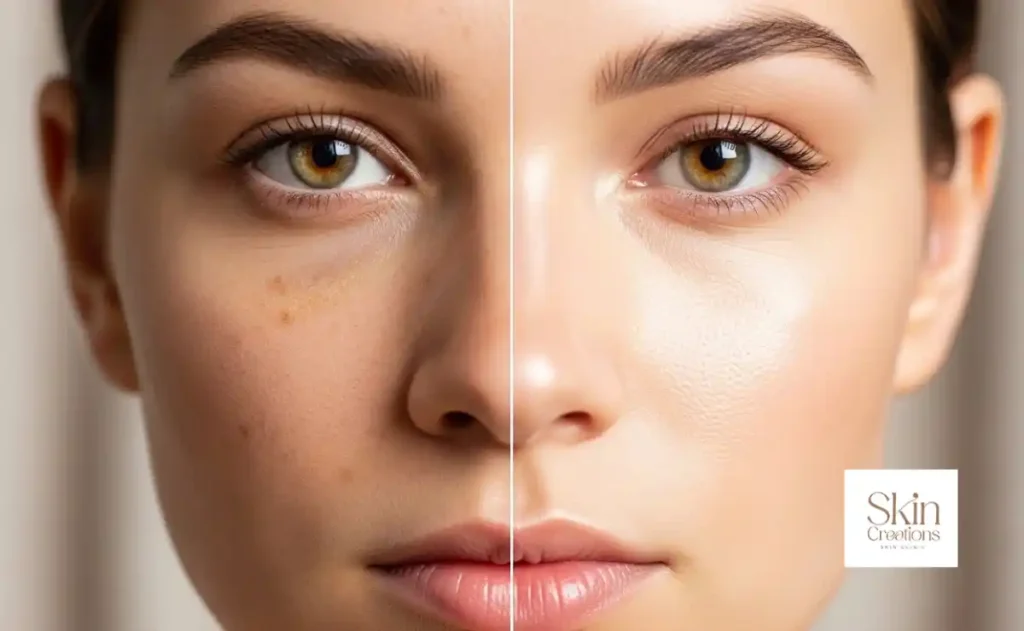
Rather than changing natural skin colour, skin brightening treatments typically aim to:
- Calm excess melanin activity that leads to dark spots and patchy tone
- Gradually fade existing pigmentation without damaging surrounding skin
- Improve texture and clarity so light reflects more evenly
- Support healthier skin turnover, which plays a key role in long-term brightness
In Singapore, these treatments are commonly chosen to manage concerns influenced by constant sun exposure and environmental stress, such as:
- Sun-induced pigmentation and freckles
- Melasma linked to hormonal fluctuations
- Post-inflammatory hyperpigmentation (PIH), especially after acne
- Persistent dullness caused by pollution, humidity, and lifestyle factors
How Skin Brightening Treatments Work
Most skin brightening treatments don’t rely on a single action. Instead, they work by addressing several underlying processes at the same time, which is why results tend to be gradual but more stable when done correctly.
Regulating Melanin Production
Melanin is the pigment that gives skin its natural colour. When the skin is repeatedly exposed to UV light, inflammation, or hormonal changes, melanin production can become uneven or excessive, leading to dark spots and patchy tone.
Many skin brightening and skin lightening treatments work by influencing tyrosinase, the enzyme involved in pigment formation. By moderating excess melanin activity rather than stopping it completely, these treatments help reduce pigmentation while keeping the skin healthy and resilient.
Encouraging Healthier Skin Cell Turnover
As skin matures, its natural renewal cycle slows. Dead skin cells linger on the surface longer, which can make the complexion look dull and cause pigmentation to appear more pronounced.
Treatments that support cell turnover help the skin:
- Gently shed pigmented surface cells
- Reveal clearer, fresher skin underneath
- Absorb brightening and repair ingredients more effectively
This process is essential for long-term improvement rather than short-lived glow.
Strengthening Skin Repair and Hydration
Brightness isn’t only about pigment. Well-hydrated, well-supported skin reflects light more evenly, which naturally improves radiance.
Many brightening and face brightening treatments also focus on improving hydration, supporting collagen, and strengthening the skin barrier. This is especially relevant in Singapore, where frequent transitions between humidity and air-conditioning can quietly weaken the barrier and make skin more prone to dullness and pigmentation over time.
Common Types of Skin Brightening Treatments in Singapore
Skin brightening treatments don’t all work the same way. Some approaches focus on surface renewal, others target deeper pigmentation, and some improve overall skin quality to enhance radiance. The most suitable option depends on pigmentation type, skin sensitivity, and acceptable downtime.
In-clinic face brightening treatments focus on improving uneven tone, dullness, and early pigmentation through controlled exfoliation, pigment regulation, and skin-repair support. When tailored to individual skin needs, they are often used alongside topical care to improve clarity while maintaining skin comfort and balance over time.
1. Topical Brightening Treatments
Topical treatments are often the starting point for skin brightening, especially for mild or early pigmentation. These are usually dermatologist-prescribed or medical-grade formulations designed for regular use and are commonly part of broader skin whitening treatment plans in Singapore.
Common brightening ingredients include:
- Vitamin C for antioxidant support and tone clarity
- Niacinamide to improve pigmentation and strengthen the skin barrier
- Alpha arbutin and tranexamic acid to help regulate melanin activity
- Retinoids to support skin renewal and texture
Best suited for:
Mild pigmentation, maintenance care, and first-time treatment plans
What to expect:
Results develop gradually and rely on consistent, long-term use.
2. Chemical Peels
Chemical peels work by using controlled exfoliating acids to remove damaged surface cells and encourage healthier skin renewal. Depending on the formulation, they can target anything from dullness to more established pigmentation.
Common options include:
- AHA peels for uneven texture and surface dullness
- Combination or TCA-based peels for deeper pigmentation
- Lactic or mandelic acid peels for more sensitive skin types
Best suited for:
Uneven skin tone, post-acne marks, and sun-related pigmentation
Downtime:
Ranges from minimal to moderate, depending on peel strength and skin response.
3. Laser and Light-Based Treatments
Laser and light-based treatments address pigmentation more directly by breaking down melanin clusters beneath the skin’s surface. Options such as laser skin lightening treatment are commonly used for stubborn freckles and sun spots.
In Singapore, clinics often use:
- Q-switched lasers
- Pico lasers
- IPL (intense pulsed light)
Best suited for:
Freckles, sun spots, and certain types of pigmentation, including melasma with careful assessment
Important consideration:
Treatment experience matters, particularly for medium to darker skin tones, where improper settings can worsen pigmentation.
4. Injectable Skin Boosters and IV Treatments
Some brightening approaches focus less on pigment removal and more on improving overall skin quality from within. These treatments are sometimes associated with broader terms such as skin whitening or full body whitening treatment, but their role is largely supportive rather than corrective.
They may include:
- Glutathione-based formulations
- Antioxidant infusions
- Hyaluronic acid skin boosters
Best suited for:
Dullness, uneven texture, and overall radiance
Worth noting:
These treatments don’t replace pigment-targeting options but can enhance results when used alongside them.
What Results Can You Realistically Expect?
One of the most common misunderstandings around skin brightening treatment and face lightening treatment is how quickly results should appear. Unlike quick cosmetic fixes, meaningful brightening depends on pigmentation depth, skin type, and how consistently treatments and aftercare are followed.
Changes You May Notice Early On
In the initial stages, improvements tend to be subtle rather than dramatic. Many people notice:
- Better hydration and a healthier-looking glow
- Smoother skin texture
- A more even-looking surface tone
These early changes are signs that the skin is responding well, even if pigmentation hasn’t faded significantly yet.
Improvements That Develop Over Time
As treatments continue:
- Dark spots gradually soften and fade
- Pigmentation becomes less noticeable rather than disappearing overnight
- Skin tone looks more balanced and stable overall
Most skin brightening treatments work best as a series rather than a single session. Ongoing maintenance plays an important role in Singapore’s year-round UV exposure, where new pigmentation can form easily without proper protection.
Pre- and Post-Treatment Expectations
How well a skin brightening treatment works often depends as much on preparation and aftercare as the treatment itself.
Before Treatment
- Consistent sunscreen use helps keep pigmentation stable
- Some treatments require pre-conditioning with topical products
- Strong or irritating active ingredients are usually paused
After Treatment
- Daily sun protection remains essential
- Mild redness, sensitivity, or light peeling may occur
- In some treatments, pigmentation may temporarily darken before fading
Skipping aftercare is one of the most common reasons people experience uneven or short-lived results.
How Long Do Skin Brightening Results Last?
Skin brightening results vary from person to person, but in most cases, improvements last for several months rather than permanently. Pigment activity doesn’t stop entirely, which is why maintenance is important.
For many people:
- Early improvements last around 2 to 3 months
- More established results may last 4 to 6 months, depending on skin type and sun exposure
Without ongoing care, UV exposure, hormonal shifts, or repeated inflammation can gradually trigger new pigmentation. Maintenance typically includes:
- Follow-up treatments every 3 to 6 months
- Daily topical skincare that supports pigment balance
- Consistent broad-spectrum sunscreen
Conclusion
Skin brightening works best when treatments are chosen carefully and aligned with how the skin responds over time. Factors such as sun exposure, climate, and daily habits all influence how results develop and how long they last. By understanding the available options, setting realistic expectations, and viewing brightening as ongoing care rather than a one-off solution, results tend to look more even and natural. When approached thoughtfully, skin brightening can improve clarity and balance without compromising overall skin health.
Because skin behaves differently from person to person, professional assessment plays an important role in achieving stable, natural-looking results. Consulting an experienced aesthetic clinic in Singapore helps guide treatment choices based on skin behaviour, pigmentation type, and long-term care rather than short-term fixes.
FAQs
1. How many sessions are usually needed for skin brightening treatment?
Most people see noticeable improvement after a series of 3 to 6 sessions, depending on the type of treatment and pigmentation depth. Maintenance sessions help sustain results.
2. Can skin brightening treatments make pigmentation worse?
They can if treatments are too aggressive or aftercare isn’t followed properly. Over-treatment or early sun exposure can trigger post-inflammatory hyperpigmentation.
3. Are skin brightening treatments suitable for sensitive skin?
Yes, when selected carefully. Gentle options and barrier-focused approaches are usually prioritised first.
4. How soon will results become visible?
Some people notice improved hydration and glow within the first week. Pigmentation typically fades more gradually over several weeks.
5. Is skin brightening treatment safe for Asian skin?
When properly assessed and tailored, skin brightening and skin whitening treatments are generally safe for Asian skin. Careful treatment selection reduces the risk of PIH and uneven results.